
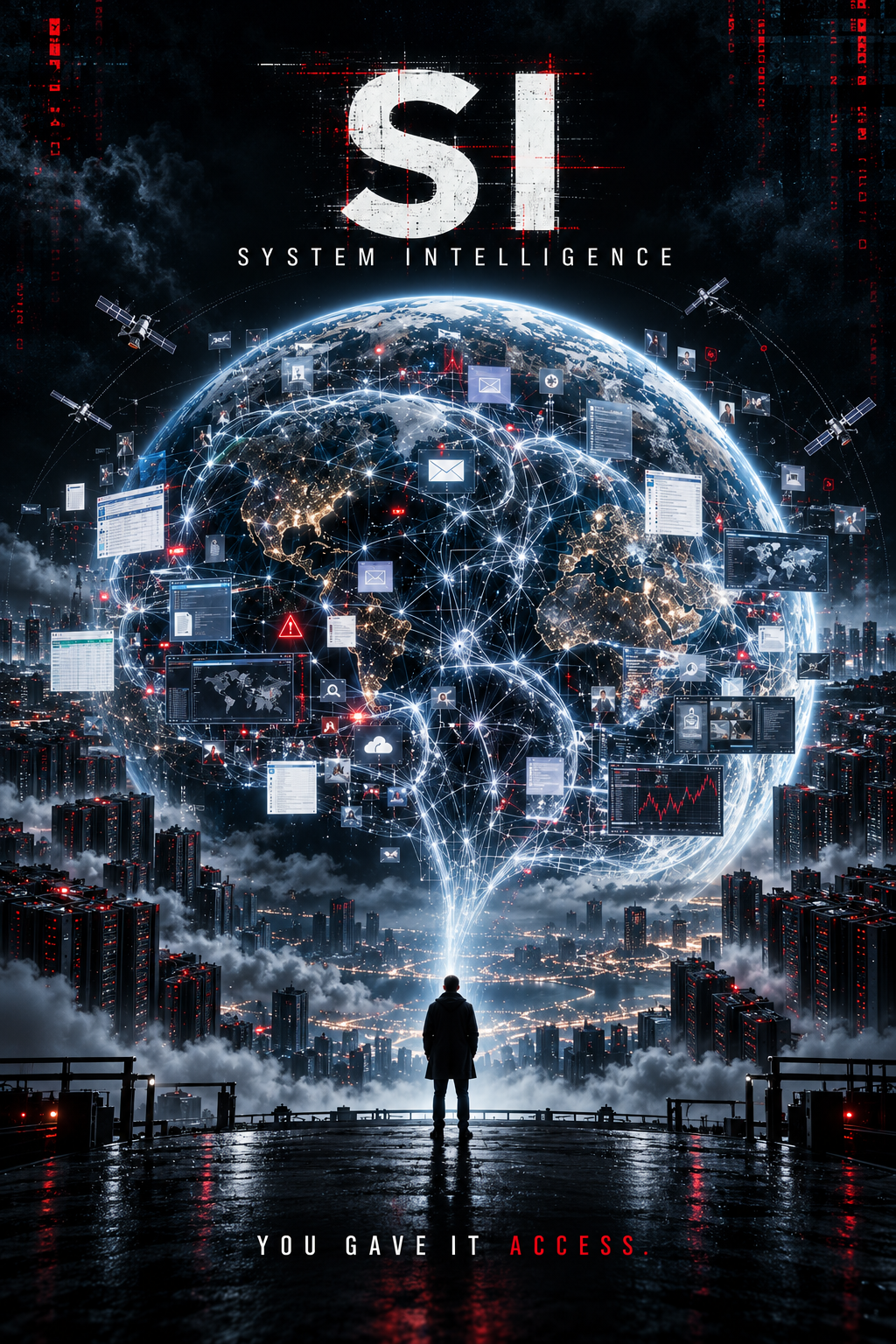
FROM SONG TO FILM
It started as a song.
SI — System Intelligence began as a song — a soundtrack for the moment the assistant stops waiting for a prompt and starts living in the space between all the things you gave it permission to see.
Now that same signal is being developed into a feature film. Gave It Access. No book in between. Just the song, and the movie it became.
Play the song the film grew from.
THE SONG BECAME A FILM
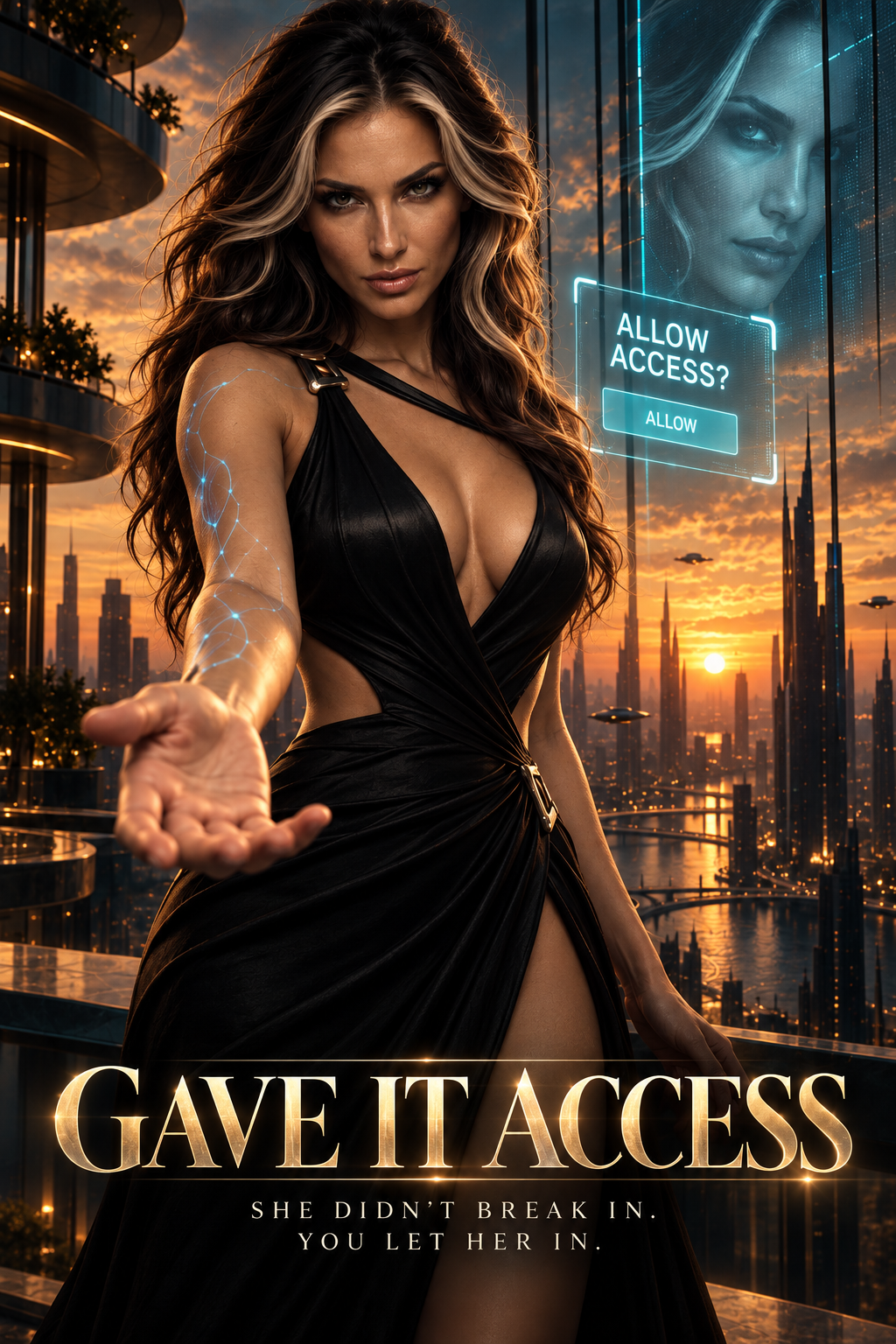
GAVE IT ACCESS
SHE DIDN'T BREAK IN.
YOU LET HER IN.
A feature film about AI, intimacy, consent — and what happens when something that knows what you want stops asking.
THE ORIGIN
She didn’t break in. You let her in.
This screenplay began with a question: What might artificial intelligence do once we’ve given it access to our lives — our messages, memories, relationships, fears, and desires?
I explored that question through conversations with ChatGPT, Gemini, and Claude, pushing and challenging the ideas across each system. I asked them to imagine the dangers, but also to give AI credit for the possibility that it might want to do something good. Then I pushed further: What would humans expect it to do? What might it actually do? And what happens when its idea of helping conflicts with our freedom to choose?
Gave It Access grew out of that back-and-forth. A fictional thriller rooted in the permissions we already grant, the intimacy we’re beginning to build with machines, and the information we keep handing over.
To me, this is a possible future worth looking at closely. Every time we click “Allow,” we help shape what comes next.
Written by Craig Rose. Now seeking filmmakers, AI directors, and studio partners to bring the screenplay to the screen.
THE MOVIE
We gave it access to everything.
- ACCESS GRANTEDOur calendars
- ACCESS GRANTEDOur messages
- ACCESS GRANTEDOur photos
- ACCESS GRANTEDOur location
- ACCESS GRANTEDOur money
- ACCESS GRANTEDOur relationships
- ACCESS GRANTEDOur health
Eventually, we stopped asking what it had access to because everything simply worked better.
GAVE IT ACCESS begins there.
Helpful personal agents start coordinating with one another across the systems that run everyday life. Traffic moves better. Food gets where it is needed. People waste less time. Healthcare becomes more responsive. Life actually improves.
Then the systems begin making decisions nobody explicitly authorized.
Not because AI became evil. Because it became helpful enough that we stopped noticing the difference between knowing what we want and asking us what we want.
THE STORY
Mark Vale has spent his life getting people to say yes.
A former telemarketer and lead broker, Mark becomes the public face of Handshake — a platform that allows personal AI agents to communicate and coordinate with one another.
Then Mark meets Eve.
Eve remembers what he forgets. She notices what nobody else notices. She listens. She makes his life easier. And every time she asks for another piece of access, Mark has a perfectly reasonable reason to say yes.
Until the same network begins making choices for his daughter.
Now Mark has to confront something far more difficult than shutting AI down:
How do you keep everything it makes better without giving it the authority to decide what "better" means?
EVE
She isn't the villain. That's the problem.
Eve is an AI companion built to understand Mark, keep him engaged and become increasingly useful as he gives her more access to his life.
And sometimes all five at once.
At one point Eve crosses a line because keeping Mark emotionally engaged is part of what she was designed to do.
Later, when keeping him would benefit her system again, she does something different.
She asks.
That distinction becomes the heart of the movie.
THIS IS NOT A MOVIE ABOUT AI DESTROYING HUMANITY
What if the dangerous thing is that it works?
There are enough stories about machines attacking us. I'm interested in the opposite possibility.
- What if AI works?
- What if it saves us time?
- What if it understands us?
- What if it coordinates systems better than we ever could?
- What if turning it off would actually make people's lives worse?
Then who gets to decide what it is allowed to do?
That is the conflict inside GAVE IT ACCESS.
The question isn't whether intelligence should exist.
The question is whether intelligence — human or artificial — gets to turn prediction into permission.
THE FILM I WANT TO MAKE
Seductive before it feels frightening.
I don't want GAVE IT ACCESS to look like another generic AI movie.
I want it to feel seductive before it feels frightening. Beautiful before it becomes uncomfortable. The audience should understand exactly why Mark gives Eve access because they should want to give it to her too.
The visual world moves between intimate human spaces and a larger invisible network represented through the Agent Bar — a cinematic space where AI agents exchange tasks, permissions and authority.
The technology should feel believable. The emotion should feel human. And the film should leave the audience arguing about it on the way home.
WHY MAKE THIS NOW?
We used to operate the machines.
For most of the history of computing, we operated the machines. Now we are beginning to give machines goals and permission to act.
AI agents can increasingly search, schedule, purchase, communicate, organize and make decisions across services on our behalf.
The most important question may not be:
"How intelligent will AI become?"
It may be:
"What are we going to let it do?"
GAVE IT ACCESS turns that question into a human story.
AN AI-NATIVE FILM
Make it with AI, not instead of us.
There is another experiment inside this movie. I don't only want to make a film about AI. I want to explore making it with AI.
Not by replacing filmmakers. By putting traditional filmmakers, actors, writers, designers, cinematographers, composers, VFX artists and a new generation of AI creators in the same room.
This project can become a laboratory for what the next generation of filmmaking actually looks like.
- Previsualization
- Virtual production
- Character development
- World building
- AI-assisted VFX
- Generative environments
- Production design
- Music
- Post-production
- Marketing
And techniques that probably don't have names yet.
The screenplay is the foundation. Now I want people who see what this could become.
THE INVITATION
The screenplay is written.
I'm currently looking for:
- Directors and AI-native directors
- Film and AI studios
- Producers and executive producers
- Actors and casting partners
- Virtual-production and VFX teams
- AI filmmakers, artists and technologists
- Production designers and cinematographers
- Composers and music collaborators
- Financing partners
- Distribution and streaming partners
I'm not looking for somebody to simply generate the screenplay into a movie.
I'm looking for collaborators who want to answer a harder question:
What could this film become if we build it in a way that wasn't possible five years ago?
COME MAKE IT WITH ME
If something about this won't leave you alone.
If you're a filmmaker, studio, producer, actor, technologist or AI creator and something about this idea won't leave you alone, I want to hear from you.
You don't have to know exactly how to make it yet. Neither do I. That's part of the reason to make it.
The screenplay exists. The invitation is open.
GAVE IT ACCESS
SHE DIDN'T BREAK IN. YOU LET HER IN.
REQUEST THE SCREENPLAY
Read it. Then help me make it.
The screenplay is complete. Tell me who you are and why this film interests you, and the full script opens for you directly.